
by
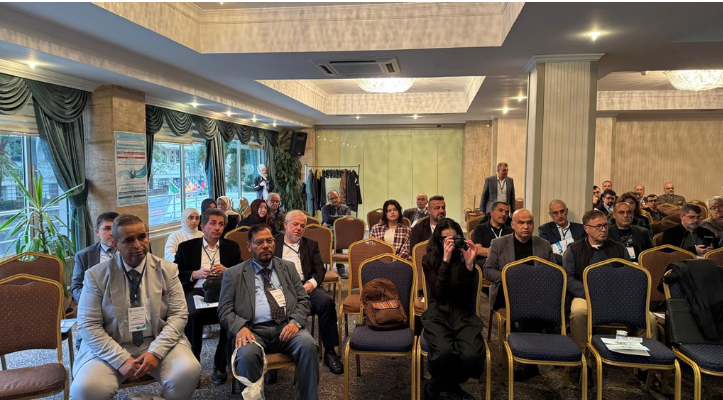
A view from the “Reinterpreting the Qur’an in the 21st Century” meeting in Ankara, Türkiye, Oct. 17, 2026. (Photo by Al-Ummah)
The 5th International Symposium on “Reinterpreting the Qur’an in the 21st Century” was held at the Gürkent Hotel in Ankara, Türkiye, on 17–18 October 2026. The event was organized by the Research Institute for the Philosophical Foundations of Disciplines whose chairman is Prof. Dr. Halil Rahman Açar.
The symposium attracted dozens of distinguished scholars and researchers from Türkiye and abroad to discuss a modern approach to Qur’anic interpretation and examine the intellectual, philosophical, theological, and methodological challenges in understanding the Qur’an in modern times.
Major Themes
A wide range of subjects came up for discussion that included the nature and meaning of divine revelation, the interpretation of the Qur’anic text, and the possibilities and limitations of innovation in tafsir (Qur’anic exegesis). Participants also examined the ontology and epistemology of the Qur’an and the relationship between revelation, historical context, and human interpretation.
Other significant discussions focused on the historicity of divine revelation, the normative character of Qur’anic provisions, the interpretation of verses concerning women, and the Qur’anic principles of justice in inheritance distribution. Scholars also explored the concept of prophetic immunity (‘ismah), the Qur’an’s approach to other sacred scriptures, and the challenges of extreme objectivism and subjectivism in religious interpretation.
Particular attention was given to the importance of interdisciplinary and collaborative approaches to Qur’anic scholarship, highlighting the need for balanced methodologies and constructive academic dialogue.
Evaluation of Today’s Muslim Thinkers
The symposium critically examined the intellectual contributions of prominent contemporary Muslim scholars and thinkers, including Abdolkarim Soroush, Javadi Amoli, Hossein Nasr, Fazlur Rahman, Nasr Hamid Abu Zayd, Youssef Al-Siddiq, Abdullah Saeed, Said Şimşek, Salih Akdemir, Mustafa Öztürk, and Muhsin Demirci.
Their approaches to Qur’anic hermeneutics, revelation, religious understanding, and contemporary Islamic thought were discussed from different methodological and intellectual perspectives.
Linguistic, Rhetorical, and Legal Dimensions
The Qur’an’s linguistic and rhetorical characteristics, particularly its metaphorical expressions and miraculous inimitability (i‘jaz), also came up for discussion. In addition, participants examined the interpretation of Qur’anic verses concerning criminal law, considering the relationship between textual interpretation, legal reasoning, and broader ethical principles.
International Academic Exchange and Conclusion
More than 45 scholars from Türkiye and abroad participated in the symposium, which encouraged dialogue among researchers representing diverse intellectual traditions and academic disciplines.
Overall, the symposium served as a valuable platform for advancing contemporary Qur’anic studies. The discussions highlighted the importance of rigorous academic inquiry, methodological reflection, interdisciplinary engagement, and collaborative scholarship in understanding the Qur’an and addressing contemporary intellectual, theological, ethical, and social questions.
The symposium marked a significant contribution to international academic discussions on the interpretation and understanding of the Qur’an in the twenty-first century.
Please Click the Link: https://al-ummah.org/en/news/scholars-explore-contemporary-approaches-to-qur-anic-interpretation